Digitalis Interactive – Project Proposal
Exploring forced-perspective in interactive 3D environments using head-mounted displays
November 9, 2009
Forced-perspective is formally implied by Desargues' theorem in projective geometry and informally demonstrated by tourist photographs of the Leaning Tower of Pisa.
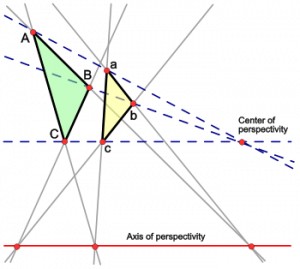
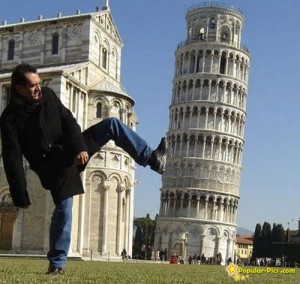
In other terms, forced-perspective is an optical technique by which an object's apparent distance from the observer is made different from its actual distance. In the above left diagram, the observer is stationed at the point labeled "Center of perspectivity." From this observational position, points A and a will reside along the same perspective ray and will therefore appear synonymous with one another. Similarly, triangle ABC will appear synonymous with abc, though the former is of greater proportion and further from the observer than the latter. By this principle, it is possible for the figure in the above right photo to appear as if he is holding up the Leaning Tower, despite his being much closer to the camera and much smaller than the tower.
The proposed project relates to an interactive 3D environment, which uses this optical principle as its central premise:
With a head-mounted display (HMD), the user is situated within a computer-generated environment – a furnished room, perhaps. A particular point in the room is stipulated as the Center of perspectivity to which all forced-perspective transformations are relative. The user may travel to and away from this position. The room is initially a normal, non- forced-perspective environment, but the user is able to push or pull any object in the environment along its forced-perspective path away from or toward the Center of perspectivity. In one iteration, this system may take on the character of a game in which a flag is placed far out of the user's initial reach. By moving objects in forced-perspective, the player creates a ladder of sorts, composed of displaced objects, which he or she then uses to climb up and grab the flag to advance to the next level.
There are several ways of obtaining the player's three-dimensional position and I want to continue to explore these options for a few more days before beginning the technical work of this project. However, I believe that the combination of two or three methods of achieving positional data may be necessary. Ideally, the HMD would house both accelerometer and digital compass or gyroscope for the purpose of accurately tracking the location and orientation of the camera within the computer-generated environment. These sensors, however, will not be of much use in mapping the user's forced-perspective pushing and pulling of objects. For this, a sensor which takes the user's full body into consideration is required. I was at first thinking of the Wii-like infrared approach. But I was recently introduced to a much more interesting technique that I would love to work with and which I believe would be the ideal way of approaching the challenge of physical interactivity for this project. Structured Light 3D Scanning would allow relatively high-resolution scanning of a 3D environment with respect to a particular perspective point. I'm still looking into this and thinking about how it can be applied to this system. More details to come on that.